Pokie Machines to Play in Australia: Rules and Odds
 Available in AU
A practical overview of online legality, game mechanics, RTP limits and the differences between Perth and Victorian casino pokies.

Table of Contents
- Online Pokies in Australia: What the Rules Allow
- How Pokie Machines Differ in Volatility and Play Structure
- Free Pokie Play: What a Demo Can and Cannot Show
- Land-Based Casino Pokies: Perth and Victoria Compared
- Game Features, Paylines and Progressive Jackpots
- Pokie Odds: What RTP Can—and Cannot—Tell You
- Real-Money Online Play: Legal Exposure and Practical Risk
- Pokie Apps, Deposits and Withdrawal Terms
- Recognisable Pokie Titles and Their Mechanics
- RTP Checks and a Fixed Session Budget
Online Pokies in Australia: What the Rules Allow
The legal position turns on who provides the game and who plays it. Under the Interactive Gambling Act 2001, an operator commits an offence by offering real-money online pokie games to people living in Australia. No Australian licence is available for an operator to offer that service to Australian residents. An offshore licence does not change that domestic position or make the offer lawful in Australia.
That rule concerns the operator’s conduct. It does not make an Australian resident’s act of playing an offshore real-money pokie an offence under the Act. The distinction matters: the law prohibits the service being offered to people in Australia, while the resident who uses an offshore operator is not committing an offence simply by playing. Treating those positions as identical would misstate the law.
What the prohibition covers
A pokie played through a website or app remains an online gambling service when money is wagered for the possibility of a monetary return. The format does not alter the legal category: a screen-based version of a familiar machine is still an online pokie when offered for real money. Nor does describing the product as a game, entertainment or software change the rule if the service is, in substance, real-money online pokie play.
Choosing a pokie machine is only part of the decision: the casino behind it matters too. Use these operator details as a starting point when deciding where to play, and check that the games and terms suit you.
License: Curacao Golden Pokies is listed with a Curacao license. The supplied information does not include further operator details.
Payout speed: crypto ~90 minutes, fiat 1-5 days · Min. deposit: A$30 Kingmaker lists crypto payouts at around 90 minutes and fiat payouts at 1–5 days. Its minimum deposit is A$30.
License: Curacao – Antillephone N.V. (Versus Odds B.V.) · Min. deposit: EUR 20 Thor Casino lists a Curacao license held by Antillephone N.V. (Versus Odds B.V.). Its minimum deposit is EUR 20.
License: Curacao eGaming (Roby Games Ltd) Roby Casino lists a Curacao eGaming license held by Roby Games Ltd. No further details were provided.
License: Curacao eGaming OGL/2023/174/0082 (Dama N.V.) · Min. deposit: A$15 LevelUp Casino lists a Curacao eGaming license, OGL/2023/174/0082, held by Dama N.V. Its minimum deposit is A$15.
License: Curacao Gaming Control Board OGL/2023/176/0095 (Hollycorn N.V.) GoldenCrown lists a Curacao Gaming Control Board license, OGL/2023/176/0095, held by Hollycorn N.V.
License: Curacao eGaming (Dama N.V.) JeetCity Casino lists a Curacao eGaming license held by Dama N.V. No further details were provided.
License: Curacao Gaming Control Board (TechSolutions Group N.V.) Bizzo Casino lists a Curacao Gaming Control Board license held by TechSolutions Group N.V.
License: Curacao · Min. deposit: A$20 (POLi) Lucky Dreams lists a Curacao license and a minimum POLi deposit of A$20.
Payout speed: crypto under 1 hour, PayID 1-3 business days · Min. deposit: A$20 (A$30 to qualify for the bonus) Ricky Casino lists crypto payouts in under an hour and PayID payouts in 1–3 business days. The minimum deposit is A$20, or A$30 to qualify for the bonus.
The relevant boundary is therefore not whether the game looks like a land-based machine, or whether its interface uses familiar reels and symbols. It is whether an operator is providing real-money online pokie play to people in Australia. The Interactive Gambling Act 2001 addresses the offer of that service; it does not create an Australian licensing route for it.
A website’s offshore location does not establish that its real-money games may lawfully be offered to Australian residents. Equally, an offshore licence should not be read as an Australian authorisation. The two are different things. In this market, there is no Australian licence under which an operator can lawfully offer real-money online pokies to residents.
The operator’s position and the player’s position
The operator-side offence and the player-side position should be kept separate. An offshore business that offers real-money pokies to people living in Australia falls on the prohibited side of the Act. A resident who plays those games is not, on that account alone, committing an offence under the same law.
This distinction is narrower than an endorsement. The fact that the player is not committing an offence does not make the operator’s offer lawful, and it does not turn an offshore licence into a local one. It simply identifies whose conduct the relevant prohibition addresses. Legal permission for the operator and criminal liability for the player are not interchangeable questions.
The distinction also prevents a common misreading of the phrase “illegal online pokies.” In this context, it describes the prohibited service offered to Australians, not a claim that every resident who accesses such a service has committed an offence.


Real-money play is not the same category as a free game
A free version of a pokie is not automatically the same service as a real-money game. A game that is merely presented on a screen should not be treated as equivalent without considering whether it involves real-money play.
That distinction does not create a general approval for every product labelled “free.” The label alone does not settle the legal character of a service.
A practical reading of the rule
For Australian residents, the legal position can be stated without confusing the two sides: operators are prohibited from offering real-money online pokie games to people in Australia, and no Australian licence exists for that offer. A resident’s participation with an offshore operator is not itself an offence under the Interactive Gambling Act 2001. Neither point reverses the other.
Accordingly, “available online” and “lawfully offered in Australia” are not synonyms. A game may be reachable through an offshore service, but that does not establish that the service may lawfully target or accept Australian residents. The operator’s location, the game’s branding and the player’s ability to access a site do not supply an Australian licence where none exists.
How Pokie Machines Differ in Volatility and Play Structure
A pokie’s volatility describes the pattern of its payouts, not a ranking of quality. Low-volatility games tend to return smaller amounts more frequently. High-volatility games pay less often, but a win can be larger. That difference changes the rhythm of play: one format may produce regular, modest results, while another can involve longer stretches without a payout followed by a bigger result.
Tends to return smaller amounts more frequently.
Pays less often, but wins can be larger.
Neither pattern makes a game reliably profitable. Volatility does not tell whether a particular spin will win, and a larger possible prize is not a promise that one will appear during a session. It is a way to describe how payouts are distributed over play, rather than a forecast for an individual player.
Matching volatility to a preferred rhythm
Lower-volatility games may suit players who prefer frequent, more consistent wins. Those wins are generally smaller, so frequency should not be mistaken for a higher total return. A screen showing repeated small payouts can feel active while the overall balance still moves in an unfavourable direction.
High-volatility games have a different trade-off. Their less frequent payouts may make a session feel quieter, while the possibility of larger wins gives the format its appeal. That possibility does not make the larger outcome more likely on the next spin. The practical distinction is the experience of the payout pattern, not a reliable method for choosing a winning pokie machine.
The label alone is not enough to decide whether a game will suit a particular session. A player who dislikes long gaps between payouts may find a high-volatility format uncomfortable, even if its larger potential wins are attractive. Someone who values frequent small results may prefer lower volatility, while still needing to account for the fact that those results do not guarantee a positive balance. “Best” therefore depends on the preferred pattern of play, not on volatility being universally good or bad.


Paylines and the paytable
Paylines describe the paths on which symbols can form winning combinations. Pokie titles can use different numbers of paylines, and those lines may be fixed or variable. With fixed lines, the game’s line structure is set. With variable lines, the available structure can depend on the selected settings. The distinction is part of how a game is played, not evidence that one format pays better.
The paytable explains which combinations pay and what those combinations are worth under the game’s rules. Two titles can look similar on screen yet have different paytables and different line arrangements. Comparing the artwork or theme alone therefore reveals little about how the game is structured. The relevant details are the listed combinations, the way lines are arranged, and the terms attached to each result.
Line count also needs to be read alongside the stake settings. If a game lets the player alter the number of active lines, changing that setting can change the structure of the spin and may change the total amount staked. The display should be checked before play so that the selected stake is understood as a whole, rather than inferred from a single bet figure. A larger number of lines is not, by itself, a sign of better value.
Comparing formats without treating them as forecasts
A useful comparison separates three questions: how often payouts tend to occur, how large they tend to be, and what combinations the paytable recognises. Volatility addresses the first two in broad terms; paylines and the paytable describe the game’s structure. These are related parts of the experience, but they are not interchangeable measures.
Volatility describes the distribution of payouts over play rather than a forecast for an individual player.
For a player considering a pokie, the choice is consequently a matter of fit. A lower-volatility game may provide the more familiar rhythm of frequent, smaller wins. A higher-volatility game may have a less frequent but potentially larger payout pattern. The paytable and line settings then determine how combinations are evaluated and how a spin is configured. None of those features identifies a machine that will produce a win in a particular session.
Free Pokie Play: What a Demo Can and Cannot Show
A free demo is useful for inspecting a pokie’s presentation and controls without staking money. It can show the theme, reel layout, symbols, animations and how the game communicates a feature. It cannot establish what a real-money session will produce. Simulated play is not evidence of real-money performance, even when the same title appears in both modes.
The distinction matters because pokie outcomes come from a random number generator, with each spin determined independently. A sequence of demo results therefore does not build a pattern that can be carried into paid play. A run of wins is not evidence that the next spin is due to lose; a dry spell does not make a win more likely. The demo records a sample of simulated spins, not a forecast.
What a demo can help inspect
Free play can make a game’s structure easier to understand before money is involved. The reel arrangement and on-screen instructions may indicate how symbols connect, what activates a feature, and where the paytable or rules are displayed. The animation can also reveal the pace of play and how much screen activity accompanies a result. These are observations about the game’s interface and design, not proof of its financial performance.

A demo can also help distinguish between themes that look similar but present play differently. Some games use simple reels and minimal animation; others layer symbols, effects and feature screens over each spin. Visual complexity is not a measure of the chance or value of a result. A busy screen can make a small event feel substantial, so the paytable and rules matter more than the soundtrack.
Controls are another practical point to check. A free-play mode may show how a spin is started, where settings appear and how the game explains a bonus feature. That can reduce confusion about the interface. It does not show that a player will make better decisions with money at stake, or that the game will behave identically across every version and setting.
What simulated results cannot establish
A demo cannot demonstrate that a game is “ready” to pay, identify a winning cycle, or validate a pokie machine strategy based on past spins. Each result is independent, so previous demo outcomes have no influence on later ones. Repeating a sequence in free play does not make it a dependable method for real-money play.
Nor does a high count of simulated spins turn the demo into a guarantee. It remains a sample of random outcomes, and the results experienced in that sample can differ from a later session. The same is true in reverse: an unpromising demo run does not establish that paid play would produce the same pattern.
Attention A demo sequence does not build a pattern that can be carried into paid play; each spin is determined independently by a random number generator.
Free mode can also differ from the version available for real-money play. Game settings and the displayed RTP may vary by version or operator, so a demo should not be treated as confirmation of the terms attached to another instance of the game. The game title alone is not enough to establish that every setting matches.
Separate a demo from a bonus
“Free play” can describe different arrangements. A demo uses simulated credits and does not create a cash balance. A promotional free-spin offer is different: any resulting winnings are bonus funds and remain subject to the offer’s wagering requirements and cashout limits. The label “free” does not remove those conditions.
A measured use of a demo is therefore narrow: inspect the interface, read the rules and see how the game presents its features. It cannot price the risk of a real-money session or predict its result. A loss limit belongs to any paid session, not to the simulated one; treating practice results as a reason to increase that limit would turn a demonstration into a very poor accounting method.
Land-Based Casino Pokies: Perth and Victoria Compared
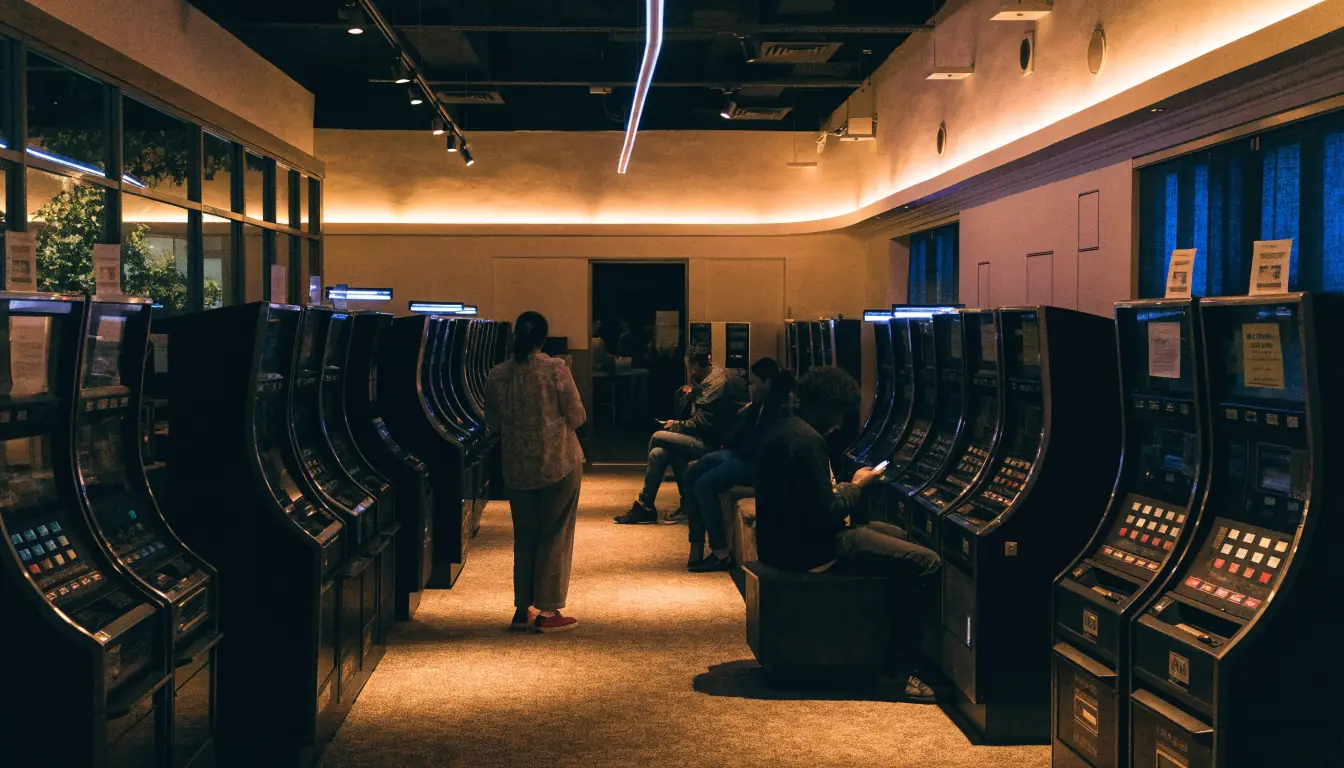
For a land-based pokie machine, the information available depends on the state and venue. Crown Perth provides a large, specific example: it is Perth’s only legal land-based casino and has more than 2,500 gaming machines. Most machines on its floor fall within an RTP range of 87% to 92%. That range describes the floor broadly, not a promise about a particular casino pokie machine.

The practical limitation is that Crown Perth does not publish an RTP list for each machine. A venue-wide range therefore cannot identify the pokie with the highest payout percentage, or establish the RTP of a machine selected for a particular session. The machine’s displayed rules, paylines and prize table provide information about how it operates, but they do not replace a machine-specific RTP figure where one is not published.
Western Australian rules require every legal pokie to display its rules, paylines and prize table. These details can help distinguish one machine from another: the prize table sets out available prizes, while the rules and paylines explain how winning combinations are assessed. That is useful for comparing game structures on the floor. It is not a ranking of machines by payout.
Victoria has a different information requirement for electronic gaming machines. The Victorian Gambling and Casino Control Commission requires EGMs to display their RTP. This gives a machine-level figure to inspect, rather than leaving the comparison at the broad floor range available for Crown Perth. It still does not make one machine a reliable source of higher returns in an individual session; the displayed percentage is a measure of the game’s return over extensive play, not a forecast for a visit.
The age condition is also explicit in Victoria: a person must be at least 18 to play an EGM. This is a venue-entry and participation requirement, separate from the information shown on a machine. The comparison is therefore not simply between two sets of games. In Perth, the available venue information includes a broad RTP range for most machines and mandatory displays of game rules, paylines and prize tables. In Victoria, the stated requirement is that each EGM display its RTP, alongside the minimum age rule.
- Check the machine’s specific rules and prize table
- Look for the displayed RTP on the machine in Victoria
- Assume a venue-wide RTP range applies to a specific machine
- Use a demo to predict real-money performance
For someone comparing an Australian pokie machine in person, the useful distinction is between what the venue publishes and what the machine displays. A general floor range cannot identify a specific machine’s percentage. A displayed RTP is more specific, but it still cannot establish which machine will produce the most favourable result during a particular session. A machine’s prize table may show its available payouts; it does not show that those payouts are more likely to occur.
The term “best” consequently needs a defined measure. If it means the largest advertised prize, the prize table is relevant. If it means the highest RTP, a machine-specific displayed figure is needed for a meaningful comparison. Perth’s published floor range cannot settle that comparison on its own, while Victoria’s display requirement makes the figure available at the machine. Neither form of information identifies a guaranteed winner.
Game Features, Paylines and Progressive Jackpots
A pokie’s feature can change how a session is priced without changing the basic accounting question: how much is committed per spin, and what additional cost is attached to an optional mechanic? Networked jackpots and feature-buy options do this in different ways. One links a prize across machines; the other charges extra to enter a bonus round.
Games such as Lightning Link, Dragon Link and Cash Express are connected across multiple machines or casinos to build a progressive jackpot. The prize is therefore networked rather than confined to a single machine. That structure can make the headline jackpot much larger, but its size alone does not establish the likelihood of winning it or the cost of a particular session. Those details depend on the game’s own rules and stake settings.

A feature-buy option changes the immediate cost more directly. Instead of waiting for the bonus feature to occur during ordinary play, the player pays an extra amount to trigger it. A specialist review has described feature-buy prices as 50 to 100 times the base bet; that is a reported range, not a standard applying to every game. The relevant figure is the price shown for the specific pokie, not a general description of the mechanic.
The arithmetic is straightforward. If the base stake is B, a feature price quoted as a multiple m costs m × B for that purchase. That charge is additional to the ordinary spin cost unless the game’s rules state otherwise. A large multiplier can therefore consume a substantial share of a session budget in one decision. The bonus feature may be triggered immediately, but the purchase does not make its outcome certain or guarantee that its value will exceed the entry cost.
Paylines can also affect how a game is configured, but the important point here is to read the purchase and feature rules together. A displayed jackpot, a bonus-buy button and the base stake are separate parts of the game’s cost structure. Treating them as one attractive headline obscures what is actually being committed.
For any pokie, the rules should be checked before play for the stake required, whether a feature-buy price is fixed or tied to the base bet, and how the jackpot is described. In free play, these mechanics can be inspected without spending money, but simulated results do not indicate real-money outcomes. The feature’s presence is a design detail; its price and conditions determine what it costs to use.
Feature-Buy Cost
Example: m × B = total cost. Where m is the feature price expressed as a multiple of the base bet B.
Pokie Odds: What RTP Can—and Cannot—Tell You
RTP is a long-run measure: it describes the share of all money wagered on a pokie that is returned to players across a very large number of spins. It is not a forecast for one person’s session, and it does not specify which spins will pay. A stated RTP therefore answers a narrow question about the game’s theoretical return over extensive play, not whether a particular session will finish ahead.
The distinction matters when comparing titles advertised as the best pokie to play. A higher RTP can indicate a higher theoretical return over the long run, but it does not make a game the best pokie to win in the short term. The result of each spin is independent; earlier losses do not make a win due, and earlier wins do not make the next result less likely to pay. A sequence can depart sharply from the long-run figure without contradicting it.
The displayed percentage may also depend on the version being played. Some providers let operators select from a range of RTP settings for the same game. As a result, the same title can have different theoretical return settings in different locations. A game name alone is not enough to identify the setting, and a percentage quoted for one version should not be assumed to apply to another.
A specialist review has reported a 96.5% RTP for Gates of Olympus and a 96.48% RTP for Sweet Bonanza. Those figures are reports about particular versions, not a universal setting for either title. The relevant comparison is the RTP attached to the specific game version in question. Without that check, a comparison based on a title’s advertised figure can be comparing different settings.
RTP is also not a promise that a stated fraction of a player’s own stake will come back. The measure aggregates wagers over a very large number of spins; it does not allocate a personal return or impose a deadline by which the theoretical result must appear. A high percentage cannot remove the uncertainty of a short session, and an individual result may be far above or below the long-run measure.
For anyone assessing pokie odds, RTP is useful as a comparison point only when the game version and setting are clear. It cannot identify a guaranteed winner or turn past outcomes into evidence about the next spin. The figure is a long-run calculation; each spin remains an independent outcome.
Real-Money Online Play: Legal Exposure and Practical Risk
For an Australian resident, the legal exposure is not the same as it is for an offshore operator. Under the Interactive Gambling Act 2001, providing real-money online casino games, including pokies, to people in Australia is an offence for the operator. A resident who plays those games through an offshore service is not committing an offence under that Act. That distinction does not make the service lawful in Australia or give the player a local regulator to turn to if a dispute arises.
The practical risk sits in the gap between being allowed to play without committing that offence and having reliable means to enforce a claim. An offshore operator may withhold winnings or fail to resolve an account dispute, and effective legal recourse may not be available to an Australian customer. A real-money pokie app does not change that position: the relevant issue is the service being provided to someone in Australia, not whether access is through an app or a website.
Legal Risk
Providing real-money online pokie games to people in Australia is an offence for the operator under the Interactive Gambling Act 2001.
The Australian Communications and Media Authority (ACMA) is the federal agency that enforces the Act and monitors compliance with national interactive-gambling rules. It can ask internet service providers to block sites that supply prohibited services or advertise them in Australia. Blocking is an enforcement measure, not a guarantee that every site becomes inaccessible at once; it does show that access can be disrupted after a service has attracted regulatory action.
Since November 2019, ACMA enforcement has led to blocks affecting more than 1,455 gambling and affiliate websites. Published accounts disagree on the number of illegal services that have left Australia since ACMA began enforcing the rules in 2017: one gives a figure above 210, while another reports more than 190.
These figures describe enforcement activity, not a level of protection for customers using an offshore site. A blocked domain may interrupt access, while the underlying account or payment dispute remains unresolved. Nor does a service’s continued availability establish that it is authorised to provide real-money pokies to Australians. In this market, the operator’s exposure under the law and the player’s practical ability to recover funds are separate questions; the first has a clear statutory answer, while the second may have no effective local route.
Pokie Apps, Deposits and Withdrawal Terms
A pokie app is an access route to an account, not a separate measure of the game’s value. The relevant costs sit around the play: how a deposit is accepted, what conditions attach to bonus funds, and what happens when a withdrawal is requested. App design cannot make an unlawful real-money online pokie service lawful for people in Australia.

Payment options vary by operator. An affiliate review reports that some online operators described as catering to Australians accept Visa, Mastercard, bank transfers and, increasingly, Bitcoin or Ethereum. That is a report about payment methods, not evidence that the service is legally available in Australia or that a particular transaction will be accepted. The payment method should be checked against the operator’s own terms before any account decision; availability, fees and processing conditions should not be assumed from an app listing.
A pokie machine API is not a useful shortcut for comparing the cost of play. The term may appear in technical or promotional material, but it does not establish the account’s deposit rules, withdrawal process or the specific game version being offered. Those are separate terms. The same distinction applies to a jackpot: its presence does not resolve how a withdrawal is handled or whether an account can access the game legally.
Withdrawal wording deserves closer attention than interface claims. Check when a request becomes pending, what can delay review, and whether the account is prompted to reverse a request while it is being processed. A reversal prompt changes the practical effect of the withdrawal process: funds remain available to return to play instead of leaving the account. The timing and conditions belong to the operator’s terms, not to the pokie’s mechanics.
Bonuses require a separate calculation. Free-spin winnings are bonus funds and may be subject to wagering requirements and cashout limits. A displayed bonus is therefore not equivalent to withdrawable cash; the conditions determine whether and when it can be converted. If the terms do not make those conditions clear, the headline amount is not a reliable measure of value.
Session Preparation
- Confirm the specific RTP setting for the game version
- Decide on a fixed loss limit in advance
- Read the prize table and paylines
- Check the terms for any bonus funds or wagering requirements
For Australian residents, offshore app access does not create local regulatory recourse. A polished app, familiar payment logos or an API reference cannot change that exposure. The practical comparison is the full account contract—deposit conditions, withdrawal handling and bonus restrictions—not the number of taps needed to reach a game.
Recognisable Pokie Titles and Their Mechanics
A familiar name identifies a particular game, not a reliable prediction of what a session will pay. The useful distinction is mechanical: some titles connect machines to a shared jackpot, while some other pokies offer a paid way to enter a bonus feature. Neither label establishes that a title is new, available at every venue, or offered in every version.
Lightning Link, Dragon Link and Cash Express are examples of networked jackpot games. Their machines can be linked across multiple machines or casinos, pooling contributions towards a progressive jackpot. The prize is therefore connected to a wider network, rather than being confined to the result of one isolated machine. The name alone does not reveal the current jackpot, the rules for qualifying, or whether a particular venue has the game; those details depend on the specific installation and its displayed rules.
Feature-buy mechanics work differently. Instead of waiting for a bonus to occur during ordinary play, a player pays a premium to trigger the feature immediately. A specialist review describes such purchases as sometimes costing 50 to 100 times the base bet, with the triggered feature often being free spins. That is a reported range, not a standard price across pokie titles. The actual cost and the feature awarded need to be checked in the game’s rules before play.
The comparison is mainly about how money enters the mechanic. A networked jackpot builds a prize across linked play; a feature buy adds an upfront cost to reach a bonus. The latter can change the amount at risk in a single decision substantially. A displayed feature is not a separate source of guaranteed value: its outcome remains part of the game’s random results.

Names such as Lightning Link and Dragon Link are recognisable because the networked jackpot is central to their identity. They should not be treated as a list of the newest pokies, or as evidence that the same game configuration is present everywhere. For any named title, the relevant particulars are the machine or game version, its stated rules, and the cost of the chosen play. Without those details, the title supplies recognition, not a basis for comparing likely returns.
RTP Checks and a Fixed Session Budget
Before a session, check the RTP shown for the exact pokie version and setting. A title can be offered with different RTP settings, so a figure attached to the game name alone may not describe the version in front of the player. The game information is the relevant comparison point.
RTP measures the share of total wagers returned across a very large number of spins. It is not a forecast for one session: a high RTP does not ensure a short-term win, and individual results can vary widely. Treating the percentage as a target for a particular visit turns a long-run measure into a promise it does not make.

A fixed loss limit puts a cash boundary around that uncertainty. Set the amount before play, count it as the full cost of the session, and stop when it is reached. Do not raise the limit to recover losses; that changes the planned exposure after the original budget has already been spent.
The calculation is straightforward: the budget is the maximum acceptable loss, not an estimate of likely winnings. RTP does not reduce that amount or identify when a return will occur. A game may return less than the amount wagered during a particular session, even when its stated RTP is comparatively high.
These are the useful pokie machine tips: confirm the specific RTP setting, decide the loss limit in advance, and assess the session against that limit rather than against a percentage presented as a guarantee.
Published by the Crusino Casino team.